
Enforcing JSON Outputs in Commercial LLMs
The results of our tests on the structured outputs of Google Gemini Pro, Anthropic Claude, and OpenAI GPT. DataChain used for evaluation.

Why do we want Structured Outputs for our LLMs?
Before we dive into the results, let's discuss why structured outputs for LLMs are important in the first place. When working with vast amounts of unstructured text data which may vary a great deal, we need to develop a way to pull out needed elements and structure them consistently such that all the downstream processes can function reliably. Think of it as an initial leveling of the playing field. Structured outputs are a way to do this leveling and the JSON schema is a popular choice as it is lightweight and easily parsed by computers across programming languages.
Now let's get to the goods.
The Results
The top commercial vendor offering with consistent structured outputs right out of the box appears to be OpenAI, with their latest Structured Outputs API released on August 6th, 2024. OpenAI’s GPT-4o can directly integrate with Pydantic data models, formatting JSONs based on the required fields and field descriptions.
Anthropic’s Claude Sonnet 3.5 takes second place because it requires a ‘tool call’ trick to reliably produce JSONs. While Claude can interpret field descriptions, it does not directly support Pydantic models.
Finally, Google Gemini 1.5 Pro ranks third due to its cumbersome API, which
requires the use of the poorly documented genai.protos.Schema class as a data
model for reliable JSON production. Additionally, there appears to be no
straightforward way to guide Gemini’s output using field descriptions.
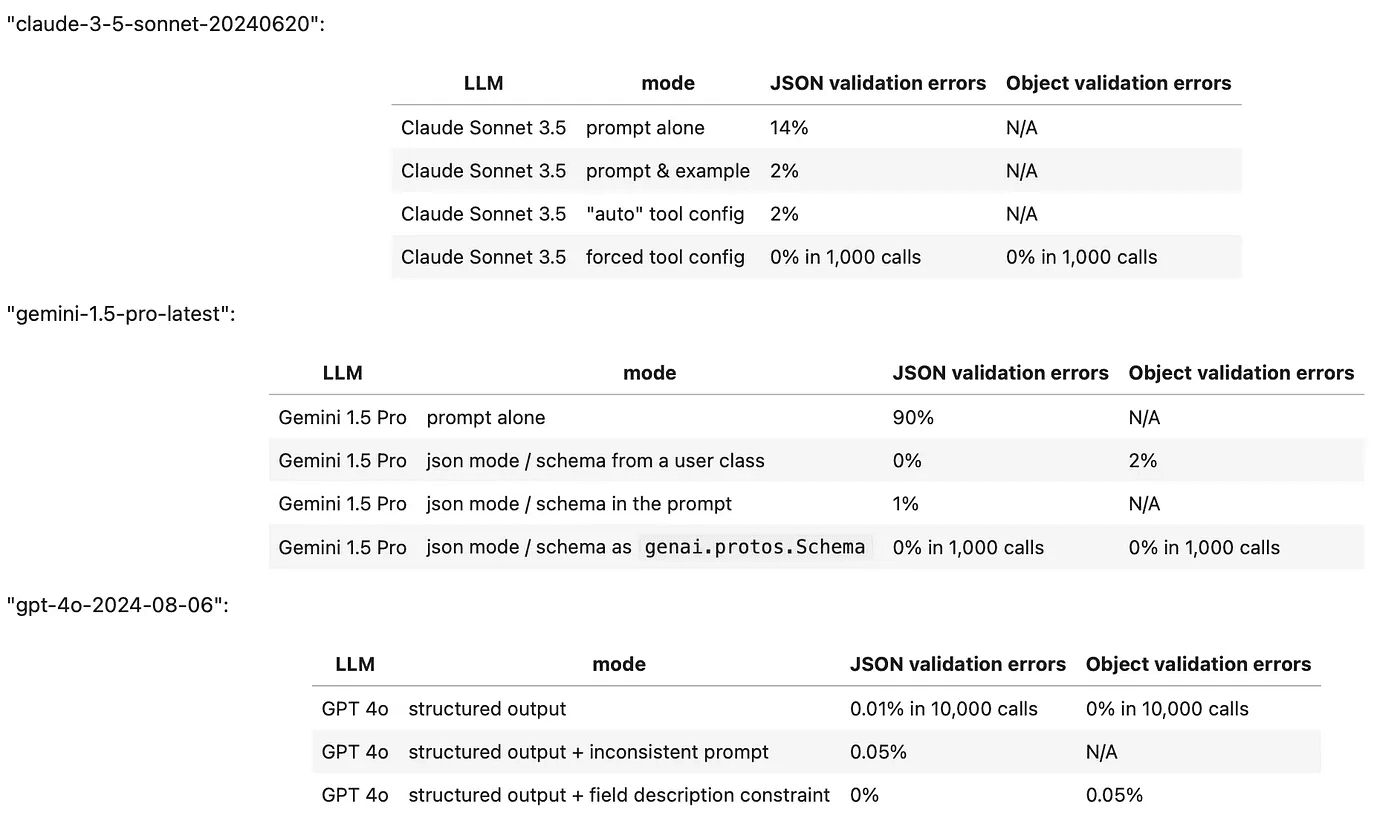
Here are the test results in a summary table:
Here is the link to the testbed notebook
Introduction to the problem
The ability to generate structured output from an LLM is not critical when it’s used as a generic chatbot. However, structured outputs become indispensable in two emerging LLM applications:
LLM-based analytics (such as AI-driven judgments and unstructured data analysis)
Building LLM agents
In both cases, it’s crucial that the communication from an LLM adheres to a well-defined format. Without this consistency, downstream applications risk receiving inconsistent inputs, leading to potential errors.
Unfortunately, while most modern LLMs offer methods designed to produce structured outputs (such as JSON) these methods often encounter two significant issues:
They periodically fail to produce a valid structured object.
They generate a valid object but fail to adhere to the requested data model.
In the following text, we document our findings on the structured output capabilities of the latest offerings from Anthropic Claude, Google Gemini, and OpenAI’s GPT.
Anthropic Claude Sonnet 3.5
At first glance, Anthropic Claude’s API looks straightforward because it features a section titled ‘Increasing JSON Output Consistency,’ which begins with an example where the user requests a moderately complex structured output and gets a result right away:
However, if we actually run the code above a few times, we will notice that conversion of output to JSON frequently fails because the LLM prepends JSON with a prefix that was not requested:
Here's the analysis of that feedback in JSON format:
If we attempt to gauge the frequency of this issue, it affects approximately 14–20% of requests, making reliance on Claude’s ‘structured prompt’ feature questionable. This problem is evidently well-known to Anthropic, as their documentation provides two more recommendations:
Provide inline examples of valid output.
Coerce the LLM to begin its response with a valid preamble.
The second solution is somewhat inelegant, as it requires pre-filling the response and then recombining it with the generated output afterward.
Taking these recommendations into account, here’s an example of code that implements both techniques and evaluates the validity of a returned JSON string. This prompt was tested using Iterative’s DataChain library across 50 different dialogs from Karlsruhe Institute of Technology’s Exbot dataset:
The results have improved, but they are still not perfect. Approximately one out of every 50 calls returns an error similar to this:
This implies that the Sonnet 3.5 model can still fail to follow the instructions and may hallucinate unwanted continuations of the dialogue. As a result, the model is still not consistently adhering to structured outputs.
Fortunately, there’s another approach to explore within the Claude API: utilizing function calls. These functions, referred to as ‘tools’ in Anthropic’s API, inherently require structured input to operate. To leverage this, we can create a mock function and configure the call to align with our desired JSON object structure:
After running this code 50 times, we encountered one erratic response, which looked like this:
In this instance, the model became confused and failed to execute the function call, instead returning a text block and stopping prematurely (with stop_reason = ‘end_turn’). Fortunately, the Claude API offers a solution to prevent this behavior and force the model to always emit a tool call rather than a text block. By adding the following line to the configuration, you can ensure the model adheres to the intended function call behavior:
By forcing the use of tools, Claude Sonnet 3.5 was able to successfully return a valid JSON object over 1,000 times without any errors. And if you’re not interested in building this function call yourself, LangChain provides an Anthropic wrapper that simplifies the process with an easy-to-use call format:
As an added bonus, Claude seems to interpret field descriptions effectively. This means that if you’re dumping a JSON schema from a Pydantic class defined like this:
you might actually receive an object that follows your desired description.
Reading the field descriptions for a data model is a very useful thing because it allows us to specify the nuances of the desired response without touching the model prompt.
Google Gemini Pro 1.5
Google’s documentation clearly states that prompt-based methods for generating JSON are unreliable and restricts more advanced configurations — such as using an OpenAPI “schema” parameter — to the flagship Gemini Pro model family. Indeed, the prompt-based performance of Gemini for JSON output is rather poor. When simply asked for a JSON, the model frequently wraps the output in a Markdown preamble
A more nuanced configuration requires switching Gemini into a "JSON" mode by specifying the output mime type:
But this also fails to work reliably because once in a while the model fails to return a parseable JSON string.
Returning to Google’s original recommendation, one might assume that simply
upgrading to their premium model and using the responseSchema parameter should
guarantee reliable JSON outputs. Unfortunately, the reality is more complex.
Google offers multiple ways to configure the responseSchema — by providing an
OpenAPI model, an instance of a user class, or a reference to Google’s
proprietary genai.protos.Schema.
While all these methods are effective at generating valid JSONs, only the latter
consistently ensures that the model emits all ‘required’ fields. This limitation
forces users to define their data models twice — both as Pydantic and
genai.protos.Schema objects — while also losing the ability to convey
additional information to the model through field descriptions:
OpenAI GPT-4o
Among the three LLM providers we’ve examined, OpenAI offers the most flexible solution with the simplest configuration. Their “Structured Outputs API” can directly accept a Pydantic model, enabling it to read both the data model and field descriptions effortlessly:
In terms of robustness, OpenAI presents a graph comparing the success rates of their ‘Structured Outputs’ API versus prompt-based solutions, with the former achieving a success rate very close to 100%.
However, the devil is in the details. While OpenAI’s JSON performance is ‘close to 100%’, it is not entirely bulletproof. Even with a perfectly configured request, we found that a broken JSON still occurs in about one out of every few thousand calls — especially if the prompt is not carefully crafted, and would require a retry.
Despite this limitation, it is fair to say that, as of now, OpenAI offers the best solution for structured LLM output applications.
Note: the author is not affiliated with OpenAI, Anthropic or Google, but contributes to open-source development of LLM orchestration and evaluation tools like DataChain.


